
So You Want to Make Jewelry… Part 3
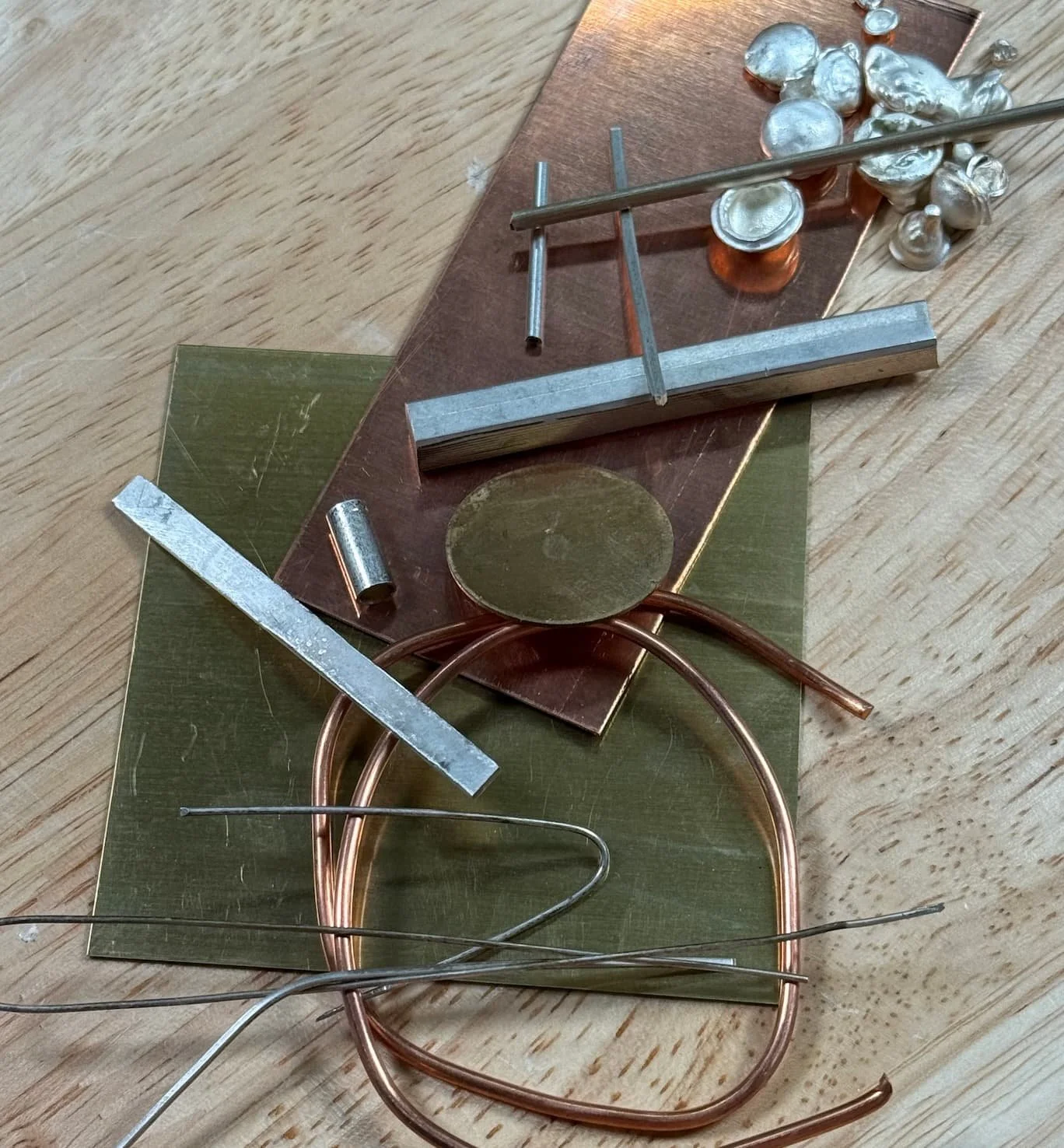
Materials for making jewelry can be the most expensive part for anyone just getting started. But they don’t have to be. In fact, when starting out and learning the basic skills of metal work, using precious metals (gold, silver, platinum) can be a huge waste of money. If you are a beginner, there are several basic metalsmithing skills to learn, and in another post I will share which ones I teach my beginning students. You can learn them using silver or gold, but these skills are the same regardless what type of metal you work with. The only difference is how each type responds to the various processes applied to it.
I always start students off using copper, brass and nickel, and of these, my first choice is copper. The reason is simple; it is the only pure metal in this group. The other two are made with a combination of metals (called alloys) that are used to create them. They are fine for learning most metal art processes, but beginning with copper a newbie jewelry maker can learn a wider variety of skills (like enameling, or foldforming) which don’t work as well – or at all with these other metals.
Metals come in three forms (four if it is used for casting or making ingots) which are wire, sheet, and tube. Learning the basic skills of sawing, filing, sanding, polishing, texturing, hammering (forging), forming, and soldering can all be done using non-precious metals. Once learned and practiced to build confidence and produce consistent results, these skills are easily transferred to working with precious metals.
All of these non-precious metals can be obtained from a local metals supplier unless you live in a remote area or maybe a small town that doesn’t have such a business. If this is the case, there are jewelry supply houses online where you can find them. Sheet metal and wire are both sold by gauge based on the B & S (Brown and Sharpe) system which is also referred to as the American Wire Gauge system. The higher the gauge number, the thinner the material. Get a couple of different gauge sizes of wire and sheet. Generally, 18 – 22 gauge is a good place to start.
Once you have the tools and materials, it’s time to get started. But which skill to learn first? Stay tuned. That’s the next post….